Egher ; Henricus Calcariensis ; Henricus de Calcaria ; Calker ; Henrici de Calcar
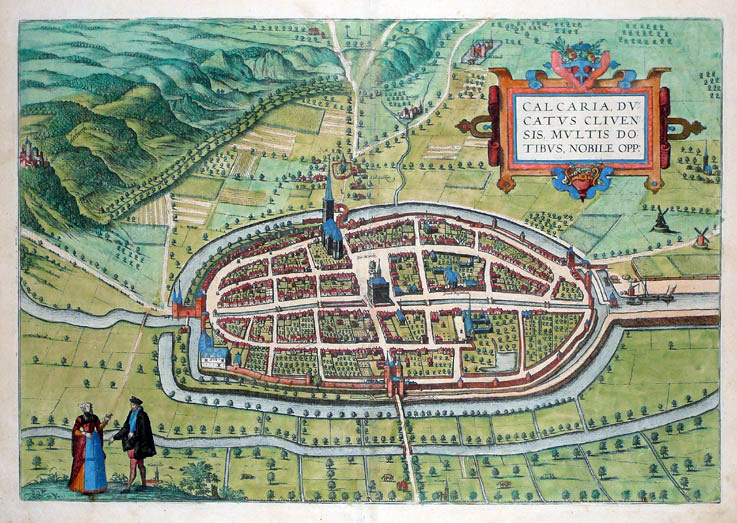 Kalkar par Frans Hogenberg, 1575.
Issu d'une riche famille patricienne, il suit sa scolarité à l'école latine de Kalkar, puis suit ses études à l'Université de Cologne, et à Paris (il a peut-être Johannis de Muris comme professeur), où il est Magister artium de la Sorbonne en 1356, magister régent en 1359 (professeur), et procureur de la nation anglaise (les étudiants sont organisés en nations). En 1362, il est doyen de la Sorbonne.
En 1363, il est chanoine à la collégiale St. Georg à Cologne et à St. Suitbert de Kaiserwerth près de Dusseldorf., où il intègre, en 1365, l'ordres des chartreux.
En 1367-1372, il est prieur à Monnikhuizen (Arnheim), puis recteur à Roermond.
de 1375 à 1395, il est visitateur de l'ordre pour l'Allemagne inférieure (Alemannia inferior : Rhein et Saxe), mais visite aussi des monastères en France, Bohème, et Moravie.
Entre 1378 et 1384, il est prieur à St. Barbara de Cologne, puis jusqu'en 1396, à Marienberge (Srasbourg).
En 1396, il regagne alors St. Barbara de cologne comme simple moine.
Cantuagium sive de musica : liber I
 Jean-Marc Warszawski
Dictionnaire des écrits relatifs à la musique
Novembre 1995-28 avril 2009
© Musicologie.org


Mougel Ambrose, Henry of Kalkar. Dans « The Catholic Encyclopedia », Encyclopedia Press, 1913.
Henry of Kalkar
Carthusian writer, b. at Kalkar in the Duchy of Cleves in 1328; d. at Cologne, December 20, 1408
Henry (EGHER) of Kalkar, Carthusian writer, b. at Kalkar in the Duchy of Cleves in 1328; d. at Cologne, December 20, 1408. Henry began his studies at Cologne, and completed them at Paris, where he became Master of Arts in 1357. He forthwith occupied the post of procurator of the German nation in 1358, being also a professor of theology. Having obtained canonries in the collegiate churches of St. Swibert in Kaiserswerth and St. George in Cologne in 1362, he returned to his native land. Soon after, however, disgusted with the world, he retired in 1365 to the Charterhouse of Cologne, where, owing to his talents and virtues, he was rapidly raised to the most important offices. Successively prior of the Charterhouses of Arnheim (1368-72), of Ruremonde (1372-77), which he had built, of Cologne (1377-84) and of Strasburg (1384-96), which he restored, and visitor of his province for the space of 20 years, he was thus called upon to play, under the trying circumstances produced by the Great Schism, a considerable role in the Netherlands and German-speaking countries. Relieved at length, at his earnest request, of all his offices, he retired in 1396 to the Charterhouse of Cologne, and there lived in recollection and prayer until his death.
Henry of Kalkar was celebrated not only as a writer, but also as a reformer. During his priorate at Arnheim he had the happiness and honor of converting one of his friends and fellow-students at Paris, Gerard Groote (the future founder of the Brothers of the Common Life), whom he attracted into his Charterhouse and directed for three years. Moreover by his spiritual writings .... he exercised on the whole school of Deventer and Windesheim the influence of a recognised master. He was to this extent the organizer of the great movement of the Catholic Renaissance, which, initiated at Windesheim and in the convents of the Low Countries, went on developing throughout the fifteenth century, finding its definite expression in the Council of Trent. He distinguished himself in the eyes of his contemporaries by his religious zeal, his great piety, and above all by his remarkable devotion towards the Blessed Virgin, who, it is said, deigned to appear to him several times. Indeed such was his reputation, that many attributed to him, though wrongly, the institution of the Rosary and the composition of the Imitation of Christ, and Blessed Canisius went so far as to insert his name in his German martyrology for December 20.
As a writer he has left a number of works on very diverse subjects. At once a man of learning and letters, a distinguished musician, theologian, and ascetic, he composed the treatises: Loquagium de rhetorica, Cantuagium de musica, De Continentiis et Distinctione Scientiarum, and was also the author of sermons, letters, treatises on the spiritual life, etc. These works, which have never been printed, are scattered about in different libraries—at Basle, Brussels, St. Gall, etc. One alone has been published and has enjoyed a strange career, the Exercitatorium Monachale or Tractatus utilis proficere volentibus. Inserted in a number of manuscripts of the Imitation between the first and third books, it has sometimes passed as an unedited book of that work, and was published as such by Dr. Liebner at Gottingen in 1842. Several times reprinted, especially by Msgr. Malou in his Recherches sur le veritable auteur de l'Imitation, it has been translated into French (Waille, Paris, 1844) under the title L'Imitation de J.C., livre inedit trouve dans la bibliotheque de Quedlinbourg. Moreover it has in great part passed into the "Mystica theologia" (chap. I) of Henry of Balma, and into the treatise De Contemplatione (lib. I, art. xxi) of Denis the Carthusian, and, after having inspired Thomas A Kempis and Garcia de Cisneros, it furnished St. Ignatius himself with some ideas for his famous "Exercises".
AMBROSE MOUGEL.
 À propos - contact |
S'abonner au bulletin
| Biographies de musiciens | Encyclopédie musicale | Articles et études | La petite bibliothèque | Analyses musicales | Nouveaux livres | Nouveaux disques | Agenda | Petites annonces | Téléchargements | Presse internationale | Colloques & conférences | Collaborations éditoriales | Soutenir musicologie.org.
À propos - contact |
S'abonner au bulletin
| Biographies de musiciens | Encyclopédie musicale | Articles et études | La petite bibliothèque | Analyses musicales | Nouveaux livres | Nouveaux disques | Agenda | Petites annonces | Téléchargements | Presse internationale | Colloques & conférences | Collaborations éditoriales | Soutenir musicologie.org.
Musicologie.org,56 rue de la Fédération, 93100 Montreuil. ☎ 06 06 61 73 41.
ISNN 2269-9910.
Dimanche 11 Février, 2024